
Testament
A testament is one of the most important documents a person can write during a lifetime. If it does not exist, the division of property is not determined by your wishes, but by the law. In the practice of funeral services, we often encounter situations where the family discovers after death that the testament does not exist or is not valid. This subsequently complicates the inheritance proceedings and communication between the bereaved. In this guide, we will explain how to write a testament, what types of testaments exist, when a testament is invalid, and we will also add a simple free testament template.
What is a testament and what is it for?
In addition to the inheritance contract and inheritance by law, a last will is one of the reasons on the basis of which inheritance can occur. It is a legal document in which a person determines who will inherit property, a share in this property or specific things after his death. It allows him to decide on the distribution of property according to his own last will, not only according to the legal inheritance classes.
The entire assets of the testator are referred to as the estate, and it does not only include cash, real estate or means of transport, but also, for example, the liabilities or debts of the testator.
If there is no will at all or the will (or inheritance agreement) only decides on part of the estate, the remaining part of the estate is distributed among relatives according to the law in a precisely defined order. However, this legal arrangement does not always correspond to real relationships and life stories. This can be problematic, for example, in the case of long-term partners without marriage, more complex family relationships or when a person wishes to bequeath part of their property to someone close to them outside the family.
Writing a testament is often not just a legal step, but it makes sense for almost every adult. It helps prevent disputes between heirs and makes the entire inheritance process easier. For many people, it is also a way to bring more peace, certainty and clarity to what will be some of the most challenging times for their loved ones.
Who can write a testament?
Any fully legally competent person can write a testament. In legal documents, the person writing the testament is also referred to as the testator. However, it is important and necessary that at the time of writing the will, he or she is able to understand the significance of his or her actions and make decisions freely.
Persons between the ages of 15 and 18 who have not yet acquired full legal capacity may only draw up a will in the form of a notarial deed, even without the consent of a legal representative.
Persons over the age of 18 who have been restricted in their legal capacity may, subject to certain exceptions, also draw up a will only in the form of a notarial deed.
If a will is made during a period of serious mental disorder, under duress or in error, its validity or the validity of some of its provisions may later be questioned. This is also why many people choose to draw up a will with a notary, which provides greater legal certainty and helps prevent disputes between heirs.
What are the types of testaments in the Czech Republic?
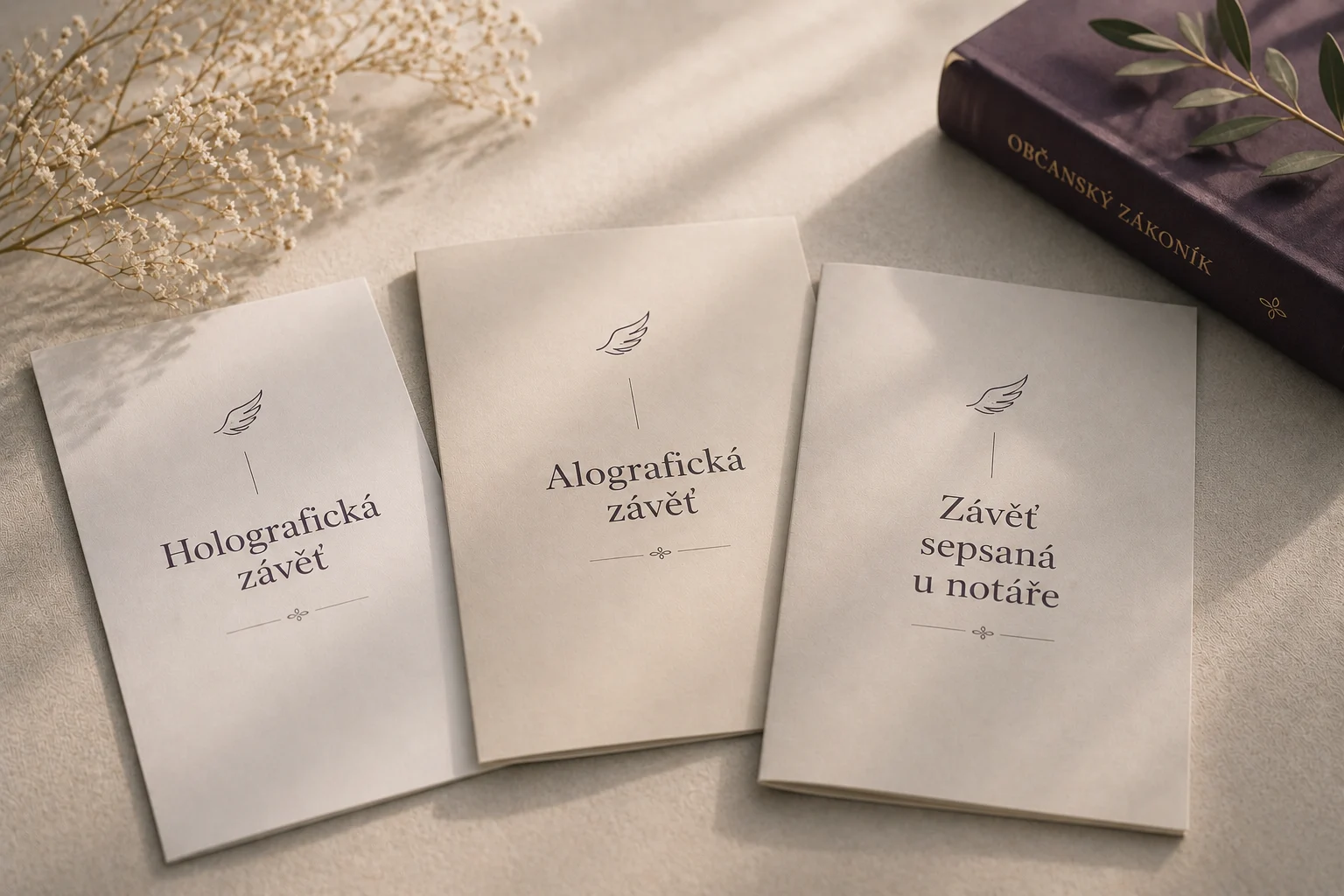
Czech law distinguishes several forms of wills. Each has its own conditions and a different degree of legal certainty.
Handwritten (holographic) will
A holographic will is written entirely in the testator’s own handwriting. It must contain a date and a handwritten signature. This form is the most common among people because it does not require a notary or witnesses.
It is important that the entire holographic will is actually written in one’s own handwriting. If a person prints the will on a computer and only signs it, it is not a valid handwritten will.
A handwritten will should clearly indicate the heirs and, ideally, the property to which it relates. Ambiguous wording can subsequently lead to disputes during inheritance proceedings.
Allographic will (written differently)
An allographic will is written in a way other than by hand, for example on a computer or by another person. In order for it to be valid, the testator must sign it in his own hand and expressly declare in front of two witnesses present at the same time that the document contains his last will. The witnesses then confirm with their signatures on the document that the will contains the true will of the testator and that the testator signed it freely and knowingly.
Witnesses must not, first of all, be a person who is incapacitated or a person who is not familiar with the language in which the will is expressed. Witnesses must also not be persons who are to inherit according to the will, nor their close relatives, or a person appointed as the executor of the will, etc.
In addition, special conditions for an allographic will apply, for example, to a blind testator or a person with a sensory impairment.
An allographic will is more demanding in terms of formal requirements and errors in its writing are not an exception.
A will drawn up by a notary
A will with a notary is the safest form of will. The notary will check the document, explain any restrictions, and ensure that the will meets all legal requirements.
The basic price for drawing up a will with a notary starts at approximately CZK 2,000, depending on the complexity of the document and the notary’s tariff.
Another great advantage is that the will is stored in the Register of Legal Proceedings for the Event of Death (ENOT). Thanks to this, the notary will automatically find the will during inheritance proceedings and there is no risk of it being lost or hidden by someone.
Privileged (emergency) will
A privileged will is used in emergency situations where life is at risk, such as during a serious accident, war or on board an aircraft or ship. It can be made under simplified conditions in front of witnesses or an official, even orally.
However, this form of will is only temporary and is usually valid for only 3 months.
What kind of will is the safest?
Each form of will has its advantages and limitations. For less complicated family situations, a will written by hand may be sufficient. Its advantage is simplicity and the possibility of writing it without the presence of other people. However, it is this variant that gives rise to the most disputes about the validity or authenticity of the document.
A will written by a notary provides greater legal certainty. The notary will check the correctness of the wording, point out any legal restrictions, and ensure that it is filed in a central registry. This makes it easier to find the will after the person’s death.
On the other hand, allographic wills, i.e. those written on a computer or by another person, are most often problematic with formal requirements. Often, the correct confirmation of witnesses is missing or not all conditions are met.
The choice of the appropriate form therefore usually depends on the family situation and the level of security that a person expects.
What must a will contain? Will checklist
A will must contain several basic requirements, as the most common problems arise precisely because of missing information.
The will should contain in particular:
- full name and address of the testator,
- date of writing (day, month and year),
- clear identification of heirs,
- ideally the date of birth of the heirs,
- description of property or shares,
- unambiguous expression of will,
- the testator’s handwritten signature,
- signatures of witnesses along with their identification details and a statement that they are witnesses (if witnesses are required to make a will).
It is recommended to use as precise a wording as possible. For example, instead of “apartment in Prague”, it is more appropriate to state a specific address or title deed number.
However, the specific requirements will always depend on the type of will chosen.
What people most often forget when writing a will
When writing a will, details are also important. People sometimes forget to state the exact date of writing or to adequately identify the heirs. Problems can also arise when the will does not correspond to the current life situation, for example after a divorce, the birth of a child or a change in property. In handwritten wills, illegible text or a missing signature are also common mistakes. Such formalities can then cause unnecessary disputes between loved ones during inheritance proceedings.
Sample handwritten will (2026) – free download
Below you will find a simple sample of a handwritten will. It is intended as a guide only and it is not a substitute for legal advice.
TESTAMENT
I, Jan Novák, born on 1. 1. 1970, residing at U Lesa 15, Prague, declare that in the event of my death I bequeath all my property to my daughter Jana Nováková, born on 5. 5. 2000.
This will expresses my true and free will.
In Prague on 10. 6. 2026
[handwritten signature]
This free will template is for illustrative purposes only. It can be used in common situations, such as when a person is leaving all of the assets to a single heir and family relationships are clear. However, there are cases where a universal template may not be enough, and it is advisable to consult a notary.
More complicated situations are, for example, when a person owns multiple properties, runs a business, has children from multiple relationships, or has part of the property abroad. Another sensitive area is disinheritance or the attempt to divide the property between multiple people in different shares.
It is at these specific moments that it is important that the will is formulated as precisely as possible. It is not only about legal certainty, but often also about the effort to maintain peaceful relations between the bereaved persons.
The most common mistakes when making a will
A will is often seen as a safeguard that helps prevent disputes between heirs. In practice, however, apparent details often play a decisive role. A missing signature, date, or incorrect form can lead to the document not being recognized in inheritance proceedings.
A common problem is, for example, a will written on a computer without witnesses. In the case of a handwritten will, it is important that it is actually entirely handwritten. Questions can also arise if there are doubts about whether a person acted freely and with full awareness of their decision.
The rights of loved ones are also a sensitive area. Although the failure to include permanent heirs in the testator’s will does not directly lead to its invalidity, it is a fact that undoubtedly complicates the course of inheritance proceedings. The testator’s children are legally entitled to a so-called mandatory share if they have not been validly disinherited.
When working with survivors, we also encounter situations where, after the death of a loved one, the family discovers multiple versions of a will without proper dating or a document without the necessary details. In addition to the inheritance proceedings themselves, there is often additional tension in a moment that should have been left primarily for peace, remembrance, and a joint farewell.
A forced heir. Who cannot be excluded from will?
As mentioned above, the law takes into account the protection of the closest family members. The forced heirs are the descendants of the testator, i.e. children and, if applicable, grandchildren, if these children do not inherit.
Even if these forced heirs are not listed in the will, the law grants them the right to the so-called mandatory share of the estate. Adult children must receive at least a quarter of their legal share of inheritance, and minor children even three quarters of their legal share of inheritance.
However, the mandatory share does not constitute a claim to a part of the estate, i.e. to specific property. More precisely, it is a claim to the payment of a monetary amount corresponding to the specified amount of their legal share of inheritance.
If a forced heir should be completely excluded from the inheritance by the testator’s will, a valid disinheritance must be drawn up. The reasons for disinheritance are precisely defined in the Civil Code.
Where to store your will so that your heirs can find it after your death?
Many people do not pay enough attention to where and how the will is stored. This can determine whether it will actually be found and respected after the person’s death.
Storing it at home is often the least reliable option. Although this solution seems to be the simplest, it is here that complications often arise. The document can be damaged, lost or go unnoticed if no one knows about its existence. In some cases, survivors even encounter multiple versions of the will and it is not clear which was the last valid one.
The most reliable option is to store the will with a notary in the ENOT registry. In such a case, the notary will then automatically search for it during inheritance proceedings. It is also possible to store the will with a lawyer or in a safety deposit box.
It is recommended that at least one trusted person knows that the will exists and where it is stored.
What happens if I die without a will?
If a person dies without a will or without a succession agreement, or if the will only affects part of the estate, the untouched part of the estate is then divided according to the statutory inheritance classes. The Czech legal system distinguishes six inheritance classes, with the spouse, children or parents of the deceased most often inheriting.
Complications can arise with unmarried partners or more complex family relationships. The inheritance procedure then tends to be longer and often more conflicting.
You can find more information about how the inheritance procedure works in a separate guide. (průběh dědického řízení)
Testament and funeral
After a person dies, the family first contacts the funeral home. A death certificate is issued at the registry office and then the inheritance proceedings are initiated. It is at this stage that it is determined whether a will exists and where it is stored. If it was drawn up by a notary, it is usually much easier to find it.
In practice, we encounter the fact that survivors resolve inheritance issues immediately after the funeral, when the family is still under great stress. That is why it may make sense to open similar topics during life, so that they have a close overview of the last wishes, documents and where they are stored.
You can find more information on:
- notarial proceedings after death,
- issuing a death certificate,
- or how the inheritance proceedings are carried out,
in other guides of PEGAS funeral service.
How often to update a testament
A will is not a document that a person writes once and never returns to. Life situations naturally change, and relationships, property, or ideas about who should inherit the inheritance can also change with them.
It is therefore recommended to always check the will after a significant life change. Typically after a marriage, divorce, birth of a child, death of one of the heirs, or a major change in property. If a new will is made, the older one usually loses its validity to the extent that they contradict each other.
In this regard, it is therefore necessary to always state the day, month, and year of its preparation on the will. If the date on which the will was made cannot be determined, and the testator has made multiple wills that contradict each other, this will will be invalid.
An updated will thus helps to prevent ambiguities and provides greater certainty that the person’s wishes will actually be respected.
Frequently Asked Questions about the testament
- How to write a handwritten will so that it is valid? Write the entire testament by your own hand, not on a computer. Include the date (day, month, year), identify yourself as well as your heirs and sign the will in your own handwriting. Without handwriting a holographic will is not valid. Even seemingly small formalities can later determine whether a person’s wishes will actually be respected.
- Can a testament be written by anyone? Any person with full legal capacity can write a will. Persons between the ages of 15 and 18 who have not yet acquired full legal capacity, and persons with limited legal capacity (within their limitations), may only create a will in the form of a notarial deed.
- How much does a will cost at a notary? The basic notary fee for writing a will starts at around CZK 2,000. The final amount depends on the extent of the property and the complexity of the document.
- Who inherits if there is a will? Only the persons named in the will can inherit. If, however, the will does not specify forced heirs (descendants of the testator and, if they do not inherit, then their descendants), they are entitled by law to at least the so-called mandatory part of the estate, if they have not been validly disinherited.
- How long is a will valid? A standard will is valid for the testator’s entire life and does not age. A privileged (emergency) will is only valid for a limited period, usually 3 months. The testator also has the right to revoke the will or its individual provisions at any time.
- Where to store a will so that heirs can find it after death? The safest thing is to file the will with a notary in the ENOT registry. The notary will automatically track it during inheritance proceedings and there is no risk of it being lost.
- Can a will be changed or revoked? Yes. A will can be revoked at any time during one’s lifetime, in whole or in part. Most often, a new will is made, which revokes the original document to the extent that it cannot stand alongside a later will. The change often occurs after a change in family situation or assets.
- What if there are multiple wills? If a person writes multiple wills during their lifetime, the most recent one is usually the most important. An older will may remain partially valid only in areas that do not conflict with the newer version. That is why it is important to be clear about which will is the most current and where the current will is stored.
- Can a will be contested? Yes. Heirs can challenge the validity of a will, for example, due to missing documents, doubts about the testator’s health at the time of making the will, or due to pressure during the drafting process. The correct form and precise wording help prevent such disputes.
Author: Lucie Kohoutková
We are here. Silently but firmly.
For 30 years, we have been creating unique farewells with deep meaning. We listen, we fulfill wishes.
We believe that each of us deserves a dignified ending.